Al Ain's Ancient Oases, A UNESCO Heritage Site, Preserve Millennia of History
- Zaheer Shahin
- Nov 22, 2025
- 5 min read

Updated: Nov 25, 2025
AL AIN – The sprawling oases of Al Ain, collectively designated a UNESCO World Heritage site, stand as a living testament to the ancient history and enduring agricultural traditions of the United Arab Emirates, preserving vast palm forests, 3,000-year-old irrigation systems, and historic fortifications that trace the evolution of desert civilization.

The recognition by UNESCO underscores the universal value of these sites, which form a "cultural property" representing the region's long-standing ingenuity in transforming arid landscapes into fertile, sustainable communities. The oases offer a unique window into the past, telling the story of the region's development through their physical structures and continued operation.
The video features the Muwaiji Oasis and its adjacent Qasr Al Muwaiji fort, the Al Hili Oasis with its defensive watchtowers, the sprawling Al Ain Oasis with its 147,000 date palms, and the archaeologically rich Al Qattara Oasis. These sites collectively represent millennia of human settlement and in Al Ain, United Arabi Emirates, Friday,2025 (Video and edit by Zaheer Shahin)
The Heart of the Garden City: Al Ain Oasis
At the core of this heritage is the Al Ain Oasis, a 1,200-hectare oasis of peace in the heart of the "Green City." Located just a 90-minute drive from Abu Dhabi, this magnificent oasis is home to an astonishing 147,000 date palm trees and over 100 different varieties of vegetation. The key to its survival for millennia is the ancient falaj irrigation system, an essential piece of the region’s heritage.


Gallery features the oasis's 147,000 date palm trees, shaded pathways, and the 3,000-year-old falaj irrigation system that sustains the plantation in Alain Oasis, United Arab Emirates, Friday, 22, Novmeber,2025. (Photo/Zaheer Shahin)
The two central falaj systems here, called Al Aini and Dawood, are 3,000-year-old dug-up channels that are intricately connected to bring water from the mountains and distant places. This engineering marvel continues to keep the plantation fresh and thriving even today, though the water flow can vary depending on the season. The oasis is free to enter, and visitors can explore its shaded pathways on foot, by rented bicycle, or by electric buggy. A free-to-enter Eco-Centre with interactive exhibits provides additional insight into the historical significance of the site.
Al Qattara: A Patchwork of History and Commerce
Further enriching the area's deep historical profile is the Al Qattara Oasis. While cultivated and farmed for three centuries, signs of earlier human habitation are profound. A 14-metre-long tomb on the eastern edge of the oasis, dating to the Wadi Suq Period (2000 CE to 1500 CE), has yielded a trove of 4,000-year-old artefacts, including golden pendants, a large cache of weapons, stone vessels, and pottery.


The oasis provides a comprehensive profile of the area's activities, featuring a total of nine mosques, six residences with storage and living areas, three forts, a souq (market), and numerous still-operational plantations. The Souq Al Qattara, built in the 1930s and restored in 1976, features a corridor approximately 35 metres long. Guarding this vital hub is the Al Daramakah Watchtower, built by a local family to protect the water source, which is supplied by its own falaj system drawing water from the Hajar Mountains.
Al Hili: Northern Fortifications and Ancient Homes
To the north, the lush and picturesque Al Hili Oasis covers an area of 60 hectares and contains approximately 40,000 mature palm trees over 252 farmed plots. It is home to several historic structures, including an ancient falaj and the Hamad Bin Hadi Al Darmaki (Bin Hadi) House, a fortified home whose foundation dates to approximately 1820, according to oral tradition.
The oasis and its life-giving water were of such importance that two defensive watchtowers were built to protect them. The square-shaped Sheikh Zayed Murabba watchtower, built at the command of the late Sheikh Zayed Bin Sultan Al Nahyan, stands more than eight metres high. Just 56 metres away, the round Seebat Khalifa Bin Nahyan watchtower features 1.75-metre-thick walls rising to more than seven metres. Both towers, built on artificial earthen mounds, form a protective gateway and feature classic defensive elements like machicolations and saw-toothed battlements.
The oasis features approximately 40,000 mature palm trees, ancient falaj irrigation systems, and fortified structures like the Bin Hadi House and defensive watchtowers, in Al Ain, United Arab Emirates, Friday, November 22, 2024. (Photo/Edit by Zaheer Shahin)
Qasr Al Muwaiji: A Seat of Governance
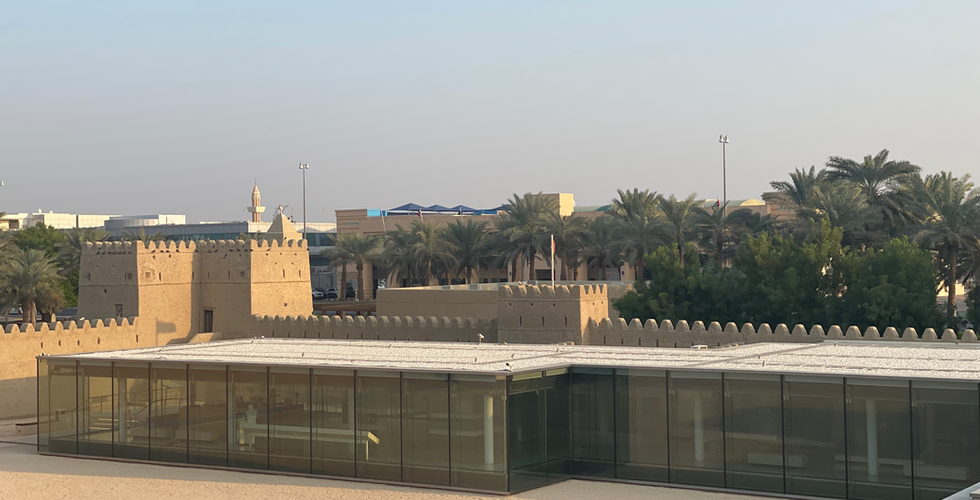
Adding to this rich tapestry is Qasr Al Muwaiji, a fort presenting a simple but striking form: a square enclosure with projecting corner towers. It was used as a Diwan (Presidential Court) and a place for the community to congregate. Sheikh Zayed bin Sultan Al Nahyan expanded the fort, adding new diwan buildings, kitchens, and guest accommodation, reflecting its growing importance. The fort’s mosque was also enlarged, cementing its role as a community focus. An exhibition hall within its courtyard now tells the story of the fort and its inhabitants, with a focus on His Highness Sheikh Khalifa bin Zayed Al Nahyan.
A UNESCO World Heritage site, undergoes significant conservation and transfers into a public museum with an exhibition focusing on its history and inhabitants Qasr Al Muwaiji in Al Ain, United Arab Emirates, friday,22, November,2025 (Graphic/Zaheer Shahin)
Adjacent to the fort is the Muwaiji Oasis, the smallest in Al Ain, which contains approximately 21,000 palm trees and is irrigated by its own falaj system that brings water from the nearby Jebel Hafit Mountain.
Together, these sites form an irreplaceable chronicle of the religious, domestic, military, and trading activities that have defined Al Ain's culture for thousands of years, preserving its story for future generations.




Broader Economic Impact
The Al Ain Oasis, a UNESCO World Heritage site, led the surge with 401,718 visitors, a remarkable 40% increase compared to the same period last year. Other key cultural landmarks saw even more dramatic growth. Visitor numbers at Qasr Al Muwaiji, the historic birthplace of His Highness Sheikh Khalifa bin Zayed Al Nahyan, jumped by approximately 50%, welcoming 168,042 guests. The Al Qattara Arts Centre also saw strong demand, attracting 163,542 visitors, a 42% year-on-year increase.

This rise in cultural site attendance coincides with a strong overall performance in the hospitality sector. Data shows that the number of hotel guests in Al Ain grew by 12% year-on-year, while a key industry metric, Revenue Per Available Room (RevPAR), increased by 7%.
Exploring Al Ain's UNESCO World Heritage sites offers a unique journey through time, from ancient agricultural ingenuity to the foundations of modern UAE governance. These oases and forts are not just historical landmarks but peaceful retreats where the past is palpably alive. Access to the Google map's location by clicking on the hyperlink for each site.
Al Ain Oasis: Located in the city center, near Al Ain Museum and the Al Jahili Fort area.
Al Qattara Oasis: Situated in the Al Qattara district of Al Ain.
Al Hili Oasis: Found in the Al Hili district, northern Al Ain.
Qasr Al Muwaiji: Located in the city center, adjacent to the Muwaiji Oasis.


Comments